
Case file 01 — Wedding planning platform
Biyekobe
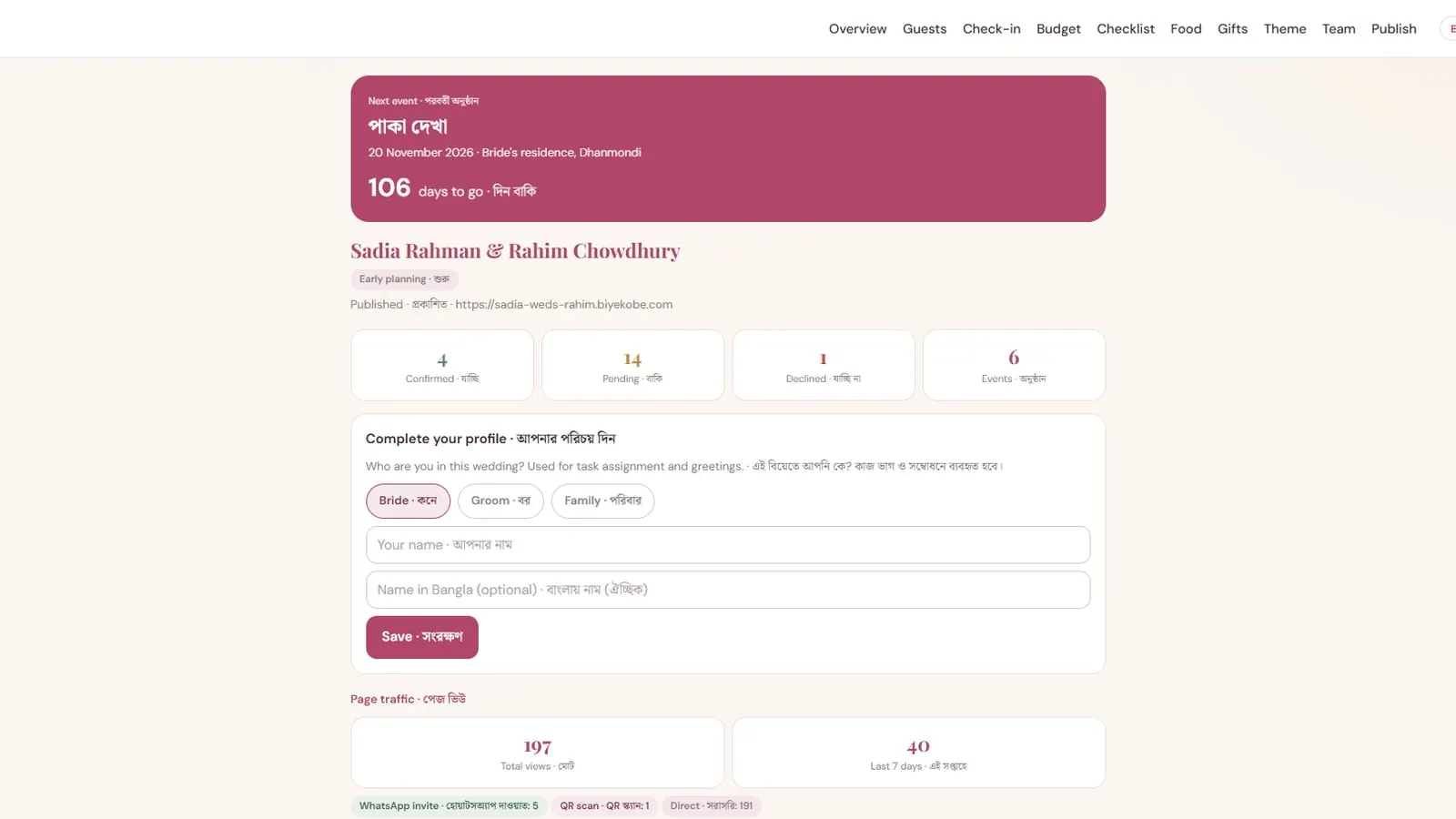
There is no wedding planner, only the illusion of control. A hundred relatives think they're the One running the show. বিয়ে কবে? gives the couple the actual source code: guests, events, tasks, money, all synced, all real-time, no illusions.
The glitch
A Bangladeshi wedding is not one event running in sequence, it's several processes forked at once: holud on the bride's side, holud on the groom's side, sometimes merged into one joint thread, then the wedding, then the reception. Each fork has its own guest list, its own permissions, its own idea of who has root access. Guests need to interact with the system without ever logging into it, over WhatsApp, on a phone with three bars of 4G in Dhaka. And the whole build had to run on trust instead of a paywall: no payments, no photo uploads, nothing to distract from the one problem worth solving.
Jacking in
Modeled the event structure the way the wedding actually runs, not the way a generic app assumes it should: holud is two separate event-rows for bride and groom sides (or one joint row), so guest lists, tasks and RSVPs stay properly forked instead of collapsing into one tangled thread.
Wrote the entire permission system directly into PostgreSQL row-level security, not app code that could be tricked or bypassed. An admin sees the whole wedding. A groom-side editor physically cannot query a bride-side guest, the database itself refuses the request. Guests never authenticate at all, they move through a single security-definer function tied to a personal invite token, a narrow door with nothing else behind it.
Shipped guest-facing wedding pages on wildcard subdomains, rendered server-side, with RSVP counts pushed to the couple's dashboard over Supabase Realtime. A "yes" typed in another city shows up on the phone at the family table within seconds. No refresh needed, the system just knows.
Made the whole platform bilingual by default (Bangla and English) with one shared string layer feeding both the web and mobile builds, and routed every invite through wa.me links instead of a paid WhatsApp Business integration, because that's the actual channel real people use.
Locked the slug the moment a wedding page goes public, enforced by a database trigger. Once a link is shared into a family WhatsApp group, it cannot break. No do-overs, no dead links, no exceptions.
Kept the guest-facing page deliberately light: no heavy JS, no bloated assets. The real target isn't a developer's laptop, it's a mid-range Android phone limping along on Dhaka 4G.