
Case file 06 — Study abroad consultancy site
Malaysia Study Guide
Every study abroad agency claims to be the one telling you the truth. Malaysia Study Guide had to actually be it: real costs, real timelines, no guaranteed-visa fantasies, a site built to survive contact with a skeptical reader who's heard every promise before.
The glitch
Study abroad agencies have a trust problem, and it's earned: vague promises, hidden costs, advice that changes depending on who's in the room that day. The brief was a site for an agency built on the opposite premise: honest cost breakdowns, no "guaranteed visa" language, and a student's first move landing on WhatsApp, not a contact form buried three clicks deep in a maze designed to slow them down. And the content itself had to answer the dozens of specific, practical questions a Bangladeshi student actually types into a search bar before ever calling an agency, because that's where the real traffic lives.
Jacking in
Built the whole system on WordPress with Bricks Builder, matching Pxelo's usual approach: design and UI/UX led by Towfiq, development and implementation by me.
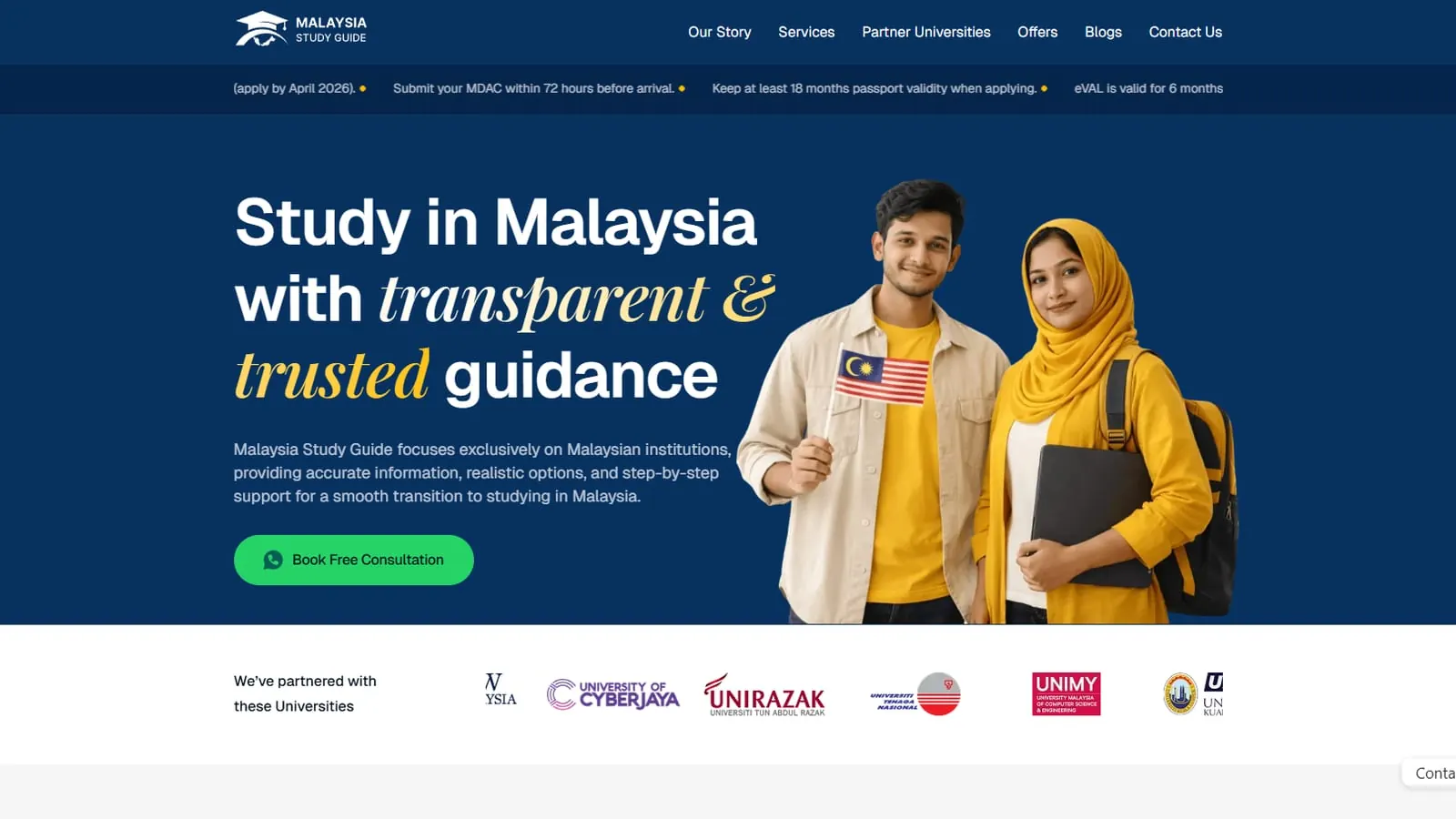
Set up a rotating notice banner for time-sensitive admission info (intake dates, application deadlines, document and visa reminders) that changes per intake cycle without a developer ever needing to touch it.
Made every primary call-to-action a direct WhatsApp link instead of a form, because that's the actual channel this audience uses, not a "someone will email you in 3 business days" black hole.
Structured the blog around real applicant questions (document checklists, part-time work rules, visa timelines) instead of generic "study in Malaysia" filler, organized into categories so the archive reads as an actual resource, not a marketing feed pretending to be one.
Built animated stat counters and a trust section (years of experience, partner universities, successful admissions, visa success rate) as the site's actual argument, not decoration bolted on afterward.
Pulled testimonials tied to a real student, their specific university and programme, because specificity is what makes a testimonial believable in a market full of generic, unattributed praise.
Structured a 10-question FAQ block answering the exact doubts an applicant already has (IELTS-optional pathways, study gaps, dependent visas, halal food availability, whether the agency even charges a fee) before they ever pick up the phone.
Set up a two-office structure (Tangail main office, Rangpur office) with separate contact details and hours per location, plus Google Site Kit wired straight into the WordPress admin for analytics and search console.